Everest Base Camp trek with kids: what families need to know before they go
Most parents researching this trek worry about the wrong thing. They picture the distance, the twelve days of walking, whether an 11-year-old can manage five hours a day with a daypack. Those turn out to be the easy parts.
*Advertisement feature*
Children can trek to Everest Base Camp, and a handful of families do it every season. Most trekking companies in Nepal set a practical minimum age of around 10 to 12, and the reason is altitude rather than fitness. There is no climbing on this route, no ropes, and no technical skill required. What the trek asks is that a child sleep above 4,000 metres (13,100ft) for six or seven nights in a row, which is a very different question from whether they can walk a long way.
If you are weighing this up as a family trip, what follows covers the things that actually decide it. The age limits operators apply, how altitude behaves in children, what the days on the trail look like, what it costs, and the shorter routes that suit younger kids far better.
Contents - jump to what you'd like to know
Can children trek to Everest Base Camp?
Yes, with conditions. Nepal sets no minimum age on the permits, so the decision sits between you and whichever company you book through.
Most established operators in Kathmandu apply their own floor of around 12 for the full trek to base camp, and look carefully at any booking involving a child under 14. Some will take a 10-year-old. Very few will take a child under 10 above Namche Bazaar, and the ones that will are worth a few hard questions.
Age matters less than two other things. The first is whether your child can describe clearly how they feel, because altitude sickness is diagnosed almost entirely based on what the person reports. The second is whether they have walked several days in a row before, on holiday, or at home, and come away wanting to do it again.
Two permits are needed, and both are bought in Nepal:
- Sagarmatha National Park entry permit, issued in Monjo or at the Nepal Tourism Board in Kathmandu
- Khumbu Pasang Lhamu Rural Municipality permit, issued at Lukla or Monjo
Children under 10 usually enter the national park free of charge. Everyone needs their passport, including the kids.
How hard is the walk itself?
The trek covers roughly 130 kilometres (81 miles) there and back, spread across 12 to 14 days. Most days involve five to seven hours of walking with a long lunch stop, and a reasonably active 13-year-old handles the distance without much complaint.
The paths are wide, well-made, and busy. You share them with mule trains and yaks, so children need to learn quickly to stand on the mountainside of the trail when animals come past.
Two climbs get remembered. The first is the long haul from the Hillary Bridge up to Namche Bazaar on day two. The second is the pull-out of the Dudh Koshi valley to Tengboche on day four. Neither is dangerous. Both are slow, and both are usually where the mood dips.
By the time you reach Lobuche, the walking has become easy, and the breathing has not. That reversal catches most first-timers out.
What are the altitude risks for a child?
This is the section that matters most, and it is where careful operators turn family bookings down.
Altitude sickness is not rare here. Headache, poor appetite, broken sleep, and mild nausea are common above 3,500 metres (11,480ft) and usually settle with rest. The serious forms, fluid on the lungs or on the brain, are uncommon but can develop within hours and can kill.
The complication with children is diagnosis. A tired, hungry 11-year-old and a child with early altitude sickness look almost identical from the outside. Younger children often cannot separate “I feel sick” from “I feel fed up” or “I want to stop walking”. You lose the early warning that an adult would give you.
What reduces the risk:
- Two full acclimatisation days, one at Namche Bazaar (3,440m / 11,290ft) and one at Dingboche (4,410m / 14,470ft). Do not let anyone talk you into dropping these to shorten the trip.
- Sleeping altitude gains of 300 to 500 metres (1,000 to 1,640ft) a day above Namche. Walk higher during the day if you like, then come back down to sleep.
- Descending straight away if symptoms do not improve with rest. Losing 500 metres (1,640ft) of altitude fixes almost everything. No medicine works as well.
- A guide with a pulse oximeter who checks the whole family morning and evening and writes the readings down.
Speak to your GP or a travel clinic before booking about whether acetazolamide is appropriate for your children. Dosing for under-18s is a medical decision, not one for a travel article.
On insurance: a standard family travel policy will not cover this. You need trekking cover valid to 6,000 metres (19,690ft) that explicitly includes helicopter evacuation and repatriation. Read the altitude limit in the full policy wording rather than the summary page. A helicopter from Lobuche to Kathmandu costs several thousand pounds if you are paying for it yourself.
What does a family itinerary look like?
The standard commercial route is 12 days on the trail. Family versions are usually built at 14, because the extra acclimatisation makes a genuine difference, and it is worth holding two spare days in Kathmandu at the end.
| Day | Route | Sleeping altitude | Walking |
| 1 | Fly to Lukla, trek to Phakding | 2,610m (8,560ft) | 3 to 4 hrs |
| 2 | Phakding to Namche Bazaar | 3,440m (11,290ft) | 6 hrs |
| 3 | Namche, acclimatisation day | 3,440m (11,290ft) | 3 hrs |
| 4 | Namche, second rest day | 3,440m (11,290ft) | Optional |
| 5 | Namche to Tengboche | 3,860m (12,660ft) | 5 hrs |
| 6 | Tengboche to Dingboche | 4,410m (14,470ft) | 5 hrs |
| 7 | Dingboche, acclimatisation day | 4,410m (14,470ft) | 3 hrs |
| 8 | Dingboche to Lobuche | 4,940m (16,210ft) | 5 hrs |
| 9 | Lobuche to Gorak Shep, then base camp | 5,164m (16,940ft) | 7 to 8 hrs |
| 10 | Kala Patthar, descend to Pheriche | 4,371m (14,340ft) | 7 hrs |
| 11 | Pheriche to Namche Bazaar | 3,440m (11,290ft) | 6 hrs |
| 12 | Namche to Lukla | 2,860m (9,380ft) | 7 hrs |
| 13 | Fly to Kathmandu | 1,400m (4,590ft) | – |
| 14 | Spare a day for flight delays | 1,400m (4,590ft) | – |
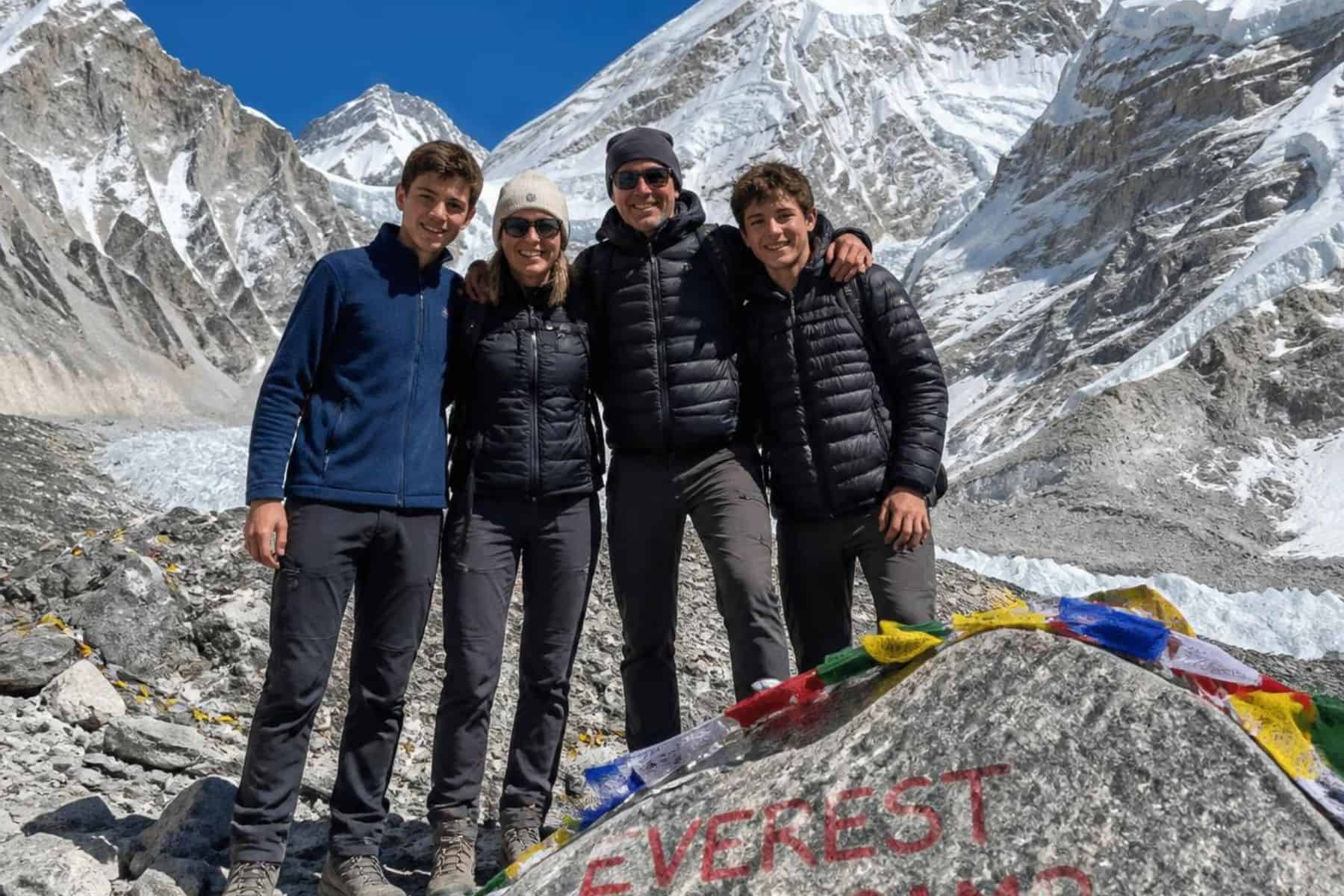
Base camp itself sits at 5,364 metres (17,600ft), and in autumn, there is very little there beyond rock, a scatter of prayer flags, and the Khumbu Icefall behind it. The climbing camps only appear in spring. Worth managing your children’s expectations about this in advance, because plenty of adults arrive and feel quietly let down.
Kala Patthar on day 10 is where the actual view of Everest is. It is a 5,545 metre (18,190ft) lump of a hill, usually climbed before dawn in the cold, and it is optional. Plenty of families skip it and sleep instead.
One detail that catches families out: in peak season, the Lukla flights do not leave from Kathmandu at all. They run from Manthali airport in Ramechhap, a four to five-hour drive that starts around 1 am. Check whether this applies to your dates and whether the transfer is in the price.
Where do families sleep and what will the kids eat?
You stay in teahouses, which are family-run lodges with twin rooms, plywood walls, and a shared bathroom down the corridor. Below Namche, they are comfortable. Above Dingboche, they are basic.
Only the dining room is heated, usually by a stove burning yak dung, and it goes out when the last person goes to bed. Bedrooms at Lobuche drop below freezing overnight. Everyone needs a sleeping bag rated to at least minus 10C (14F), which can be hired in Kathmandu for a few pounds a day.
The food is better than most parents expect. Every menu carries fried rice, chips, pasta, pancakes, porridge, soup, momos, and eggs. Dal bhat is the local meal of rice, lentils, and vegetable curry, and it comes with free refills, which teenagers work out by about day three.
A few daily costs that are rarely included in the package price:
- Charging a phone or camera costs around £2 to £3 per device, and the price climbs with the altitude
- Hot showers run roughly £3 to £5
- Wifi works through Everest Link cards sold by the gigabyte, and it is slow above Namche.
- Boiled drinking water is sold by the litre and is cheaper than bottled water.
Single-use plastic water bottles are banned across the Khumbu, so bring a refillable bottle.
Namche Bazaar is the last properly comfortable stop. It has bakeries, a Sherpa culture museum, a Saturday market, and cash machines that work perhaps half the time. Draw out more rupees than you think you need before leaving Kathmandu.
When should families go?
Two seasons work, and one of them lines up neatly with the school calendar.
| Season | Months | Suitability |
| Spring | March to May | Warm, busy, hazier views, rhododendrons in flower below Namche |
| Monsoon | June to August | Avoid. Rain, leeches, cloud, frequent flight cancellations |
| Autumn | Late September to November | Clearest skies, cold nights, the most reliable choice |
| Winter | December to February | Very cold, quiet, only for older teenagers with good kit |
October half term sits inside the best trekking weather of the year, though you will still need to take the children out of school for a week either side to fit the full itinerary.
Easter falls in the early spring window and works well, with warmer nights than autumn and slightly less reliable views.
The summer holidays are the worst possible slot. July and August are the height of the monsoon, and Lukla flights get cancelled for days at a stretch. If summer is the only window you have, look at Upper Mustang or Dolpo instead, which sit in the rain shadow behind the main range.
What should a family pack?
Boots matter more than anything else. Buy them at least two months before you fly and walk them in properly, which is harder with children whose feet are still growing.
The essentials beyond the obvious:
- A down jacket each, hireable in Kathmandu for around a pound a day
- Three or four pairs of proper walking socks, since laundry is unreliable above Namche
- A sleeping bag liner, which adds warmth and keeps a sleeping bag clean
- Factor 50 sun cream and lip balm with sun protection, as reflected glare at altitude burns fast
- Paracetamol, rehydration sachets, plasters, and blister dressings
- Snacks from home, because trail snacks in Namche cost roughly four times the UK price
- A book, a card game, or a downloaded film each, for the long evenings after dinner
Pack into a duffel bag rather than a rucksack if a porter is carrying your kit. Most families hire one porter per two people and let the children carry a small daypack with water, a jacket, and their own snacks.
What does it cost for a family?
The figures below are approximate and worth checking against live quotes, but they give you the shape of the budget.
| Item | Approximate cost |
| Guided 14-day trek, teahouse basis | £1,100 to £1,800 per person |
| Permits | Around £35 per adult |
| Trekking insurance to 6,000m (19,690ft) | £120 to £250 per person |
| Kit hire in Kathmandu | £40 to £70 per person |
| Extras on the trail | £15 to £25 per person per day |
| Guide and porter tips | £150 to £250 for the group |
A family of four should budget somewhere between £8,000 and £12,000 all in. If a quote comes in well below that, ask exactly how many acclimatisation days are in the itinerary and what the guides and porters are paid.
Is the Everest Base Camp trek right for your family?
Go if your children are 12 or older, have walked multi-day routes before, and can tell you honestly when something feels wrong. Go if you can give the trip 16 days, and if the budget can absorb a weather delay without wrecking the rest of the holiday.
Choose a shorter route if your children are under 12, if this is their first trekking trip, or if you notice you are hoping the altitude will be fine rather than believing it. The Everest View trek shows you the same mountains from 2,000 metres (6,560ft) lower down.
And wait a couple of years if you are honestly unsure. The mountain has been there a while, and it will still be there when they are 14.
Planning a family trek in Nepal?
Magical Nepal is a trekking company based in Kathmandu, running trips across the Everest, Annapurna, and Manaslu regions. Family bookings are arranged as private departures rather than fixed group dates, so an itinerary can carry the extra rest days described above without another group’s schedule dictating the pace.
Guides are government-licensed and trained in altitude first aid, and the team is straightforward about turning down a booking when the children are too young for the route. In those cases, they will usually suggest a shorter Everest or Annapurna trek instead.